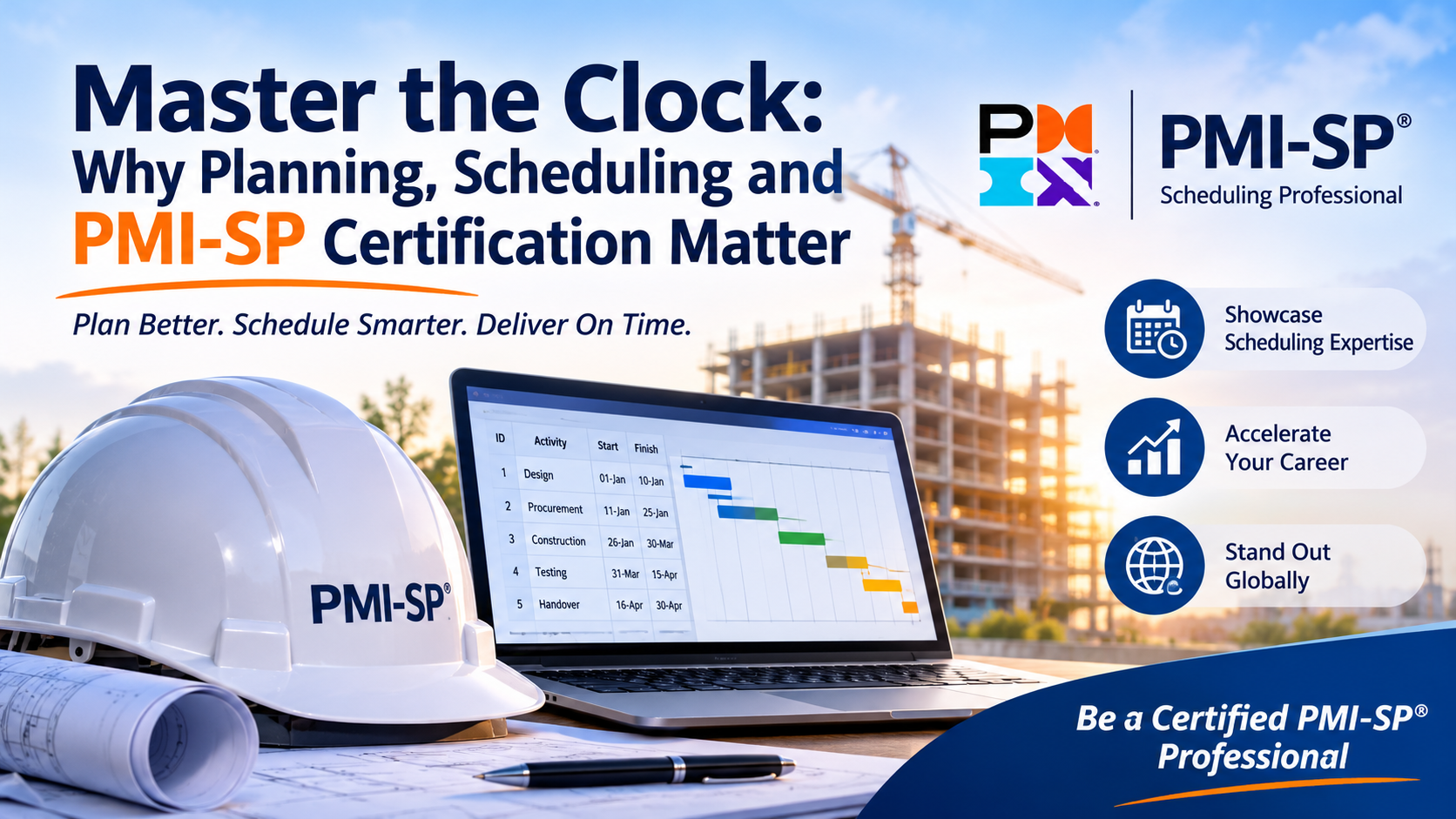
Planning and scheduling sit at the heart of successful project delivery, and recognised certification is one of the clearest ways for professionals to show they have the skills to do this work well. This article looks at why planning and scheduling matter, what the PMI Scheduling Professional (PMI-SP)® certification offers, and how recognised training certificates support a scheduler’s career. For related training, including programmes from Procons Academy, a PMI Authorized Training Partner, visit the Procons Academy website.
Why planning and scheduling matter
Time is one of the most closely watched dimensions of any project, and one of the hardest to control. In construction, infrastructure, energy and large engineering works, a slipping programme quickly turns into cost overruns, disputes and time-related claims. A reliable schedule is more than a bar chart: it is the tool the whole team, the client and the contractor use to decide, coordinate and defend their positions.
Planning and scheduling are where a project’s outcome is largely decided. Planning sets out what has to be delivered, in what order and with which resources. Scheduling turns that plan into a time-based programme that shows the critical path, where float exists, and which delays will push back the completion date. With a sound schedule, teams can spot problems early, level resources, test recovery options, and keep an auditable record of progress that supports extension-of-time and other claims.
Without it, progress is measured against nothing, and delays are discovered too late to manage. This is why specialist planning and scheduling skills, backed by recognised, verifiable certificates, matter to planners, project managers and construction professionals, and to the employers and clients who rely on them.
Why PMI-SP matters
The PMI Scheduling Professional (PMI-SP)® certification recognises people who specialise in this work. It tests the full scheduling cycle across five domains: Schedule Strategy (14%), Schedule Planning and Development (31%), Schedule Monitoring and Controlling (35%), Schedule Closeout (6%), and Stakeholder Communications (14%). Because it focuses on scheduling and not general project management, it shows an employer that the holder can build a realistic baseline, apply critical path and resource techniques, analyse variances, forecast, and explain the results to decision-makers.
The certification also supports career growth in practical ways. It gives planners, planning engineers and project managers a recognised, internationally portable credential from the Project Management Institute (PMI). Candidates must meet scheduling experience and education requirements before they can sit the exam, so the certificate also signals real field experience. Holders keep it current by earning 30 professional development units (PDUs) every three years, which encourages continued learning.
Market demand
The wider market for project professionals is under pressure. PMI’s 2025 Global Project Management Talent Gap report estimates that nearly 40 million people work as project professionals today and that up to 29.8 million more will be needed by 2035. It names construction, manufacturing, IT services and healthcare among the sectors under the greatest pressure.
Construction is especially relevant to scheduling professionals. PMI’s 2026 report on the construction project management talent gap projects that the industry will need nearly 2.5 million additional project professionals by 2035, about 60% more than in 2025. The report lists planning expertise among the most sought-after skills, together with communication and collaborative leadership. It also points to demand for professionals who are comfortable with AI tools, so responsible use of AI for schedule narratives, logic reviews, risk indicators and forecasting is becoming part of a modern scheduler’s toolkit.
These figures describe the demand for project professionals in general and are not specific to the PMI-SP credential. Even so, they show why specialist planning and scheduling skills are valuable. Large projects in Sri Lanka and abroad rely on schedulers who can use tools such as Primavera P6, manage resources, and report progress and forecasts clearly. A recognised certification helps those professionals stand out, whether they are planning engineers, project managers, construction professionals, or quantity surveyors who work closely with project programmes.
Recognised certificates
Formal training certificates add to a scheduler’s credentials. Courses delivered by PMI Authorized Training Partners award certificates of completion that record contact hours and professional development units (PDUs). Examples include Procons Academy’s Advanced Certificate in Project Planning & Scheduling and Related AI Applications (42 PDUs) and Certificate in Project Planning & Scheduling and Related AI Applications (30 PDUs), issued by Pro Consultancy International (Pvt) Ltd, an Authorized Training Partner of PMI-USA. Partner status can be verified in the PMI Authorized Training Partner directory.
Training certificates like these record the training completed and are separate from the PMI-SP® credential, which PMI awards to candidates who meet the eligibility requirements below and pass the exam. The contact hours of training are relevant to the scheduling education those requirements call for.
PMI-SP eligibility requirements
Before applying for the PMI-SP® exam, applicants must meet one of the following three sets of requirements:
|
Set |
Education |
Scheduling experience |
Scheduling education |
|
A |
Secondary degree |
40 months of project scheduling experience within the last 5 years |
40 hours of project scheduling education |
|
B |
Four-year degree |
24 months of project scheduling experience within the last 5 years |
30 hours of project scheduling education |
|
C |
Bachelor’s or postgraduate degree from a GAC-accredited program |
At least 12 months in the specialised area of professional project scheduling within the last 5 consecutive years |
30 contact hours of formal education in project scheduling (Microsoft® Project and other scheduling-tool training accepted) |
Once an application is accepted, candidates can take the exam at a Pearson VUE testing centre. The exam has 170 questions and runs for 210 minutes, with up to three attempts within one year if the candidate does not pass on the first try.
For further information on related training and certificates, visit Procons Academy: https://proconsacademy.com/advanced-certificate-in-project-planning-scheduling-and-related-ai-applications/
About Procons Academy
Procons Academy is the training division of Pro Consultancy International (Pvt.) Ltd. and a PMI® Authorized Training Partner (ATP) – USA, offering industry-focused courses and training programmes including PMP, CAPM, RMP, Primavera P6, Power BI, and more.
For details on upcoming courses and workshops,
– Visit proconsacademy.com
– Contact training@procons.lk / 074 2 540 461.
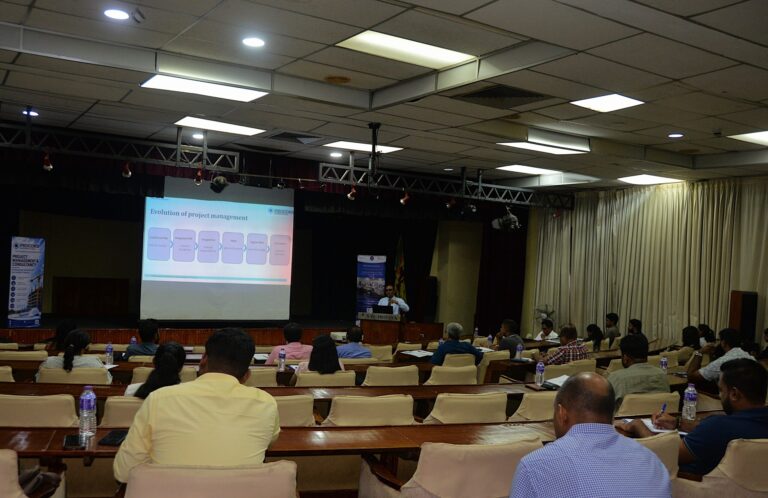
More details on this event are available on the Procons Academy linkedin page.